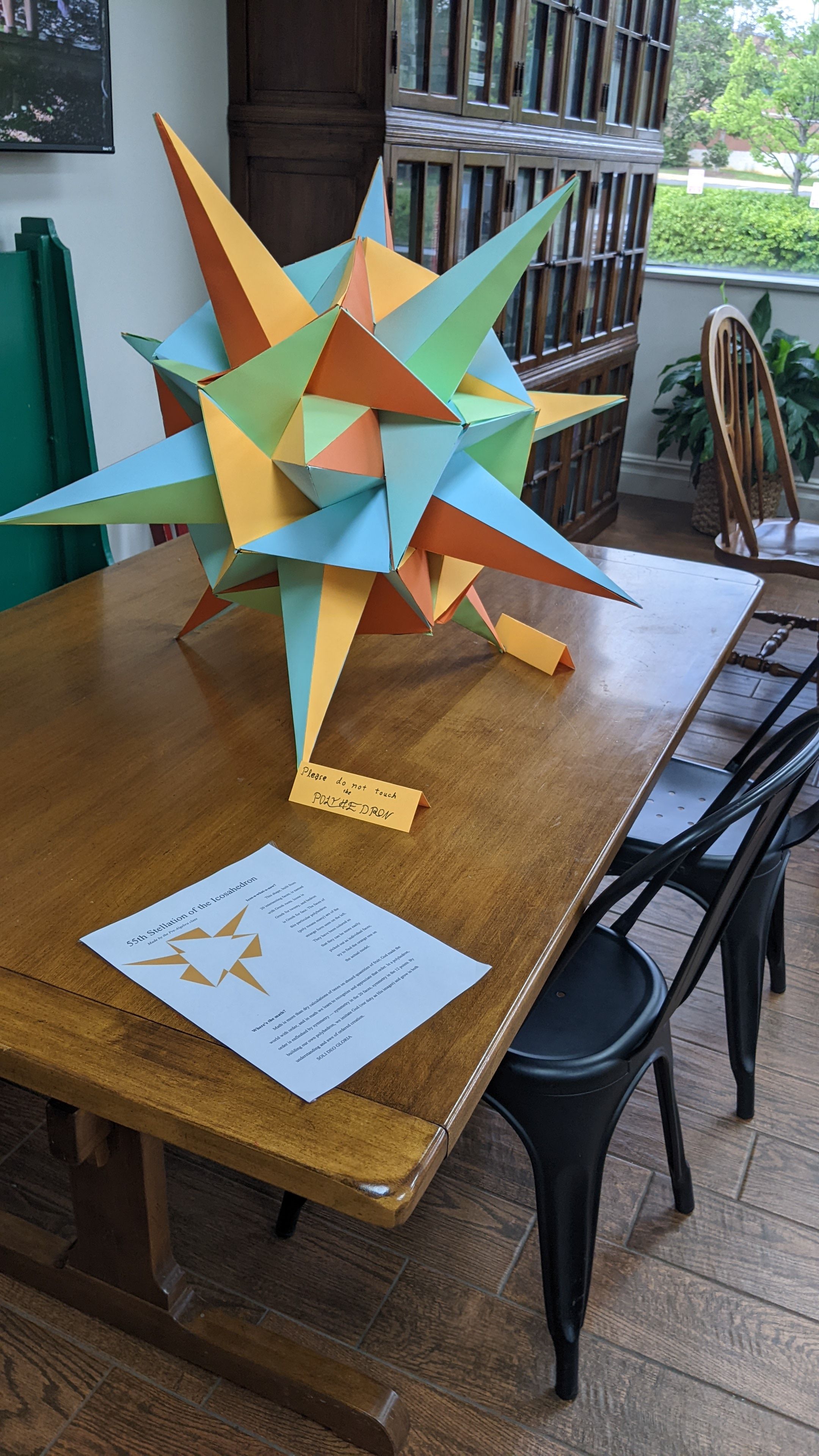
Strange symbols with no tangible meaning, mental gymnastics to turn multiple large numbers into one, and mindless processes where one small slip-up renders your result useless. Is that all math is? It’s no wonder students learn to hate math, and such a pity too, because math is one of God’s most beautiful creations. This last week the Oak Hill pre-algebra class painted a little corner of that beauty. With glue and paper they put together this model, the 56th stellation of the icosahedron, an enfleshment of God’s mathematical order in symmetry.
Polyhedra (the name for the broader class of 3D objects like the model we made) have deep roots in math. From the time of the Greeks math was synonymous with Geometry, and not just Geometry on paper, but in space. The five most basic polyhedra are even called the “Platonic Solids” after the Greek mathematician and philosopher Plato, and polyhedra have been continually studied up to this day. The shape we built, in fact, was only recently enumerated in 1938.
The world doesn’t need more people catechized in multiplication facts, it needs polyhedron builders.
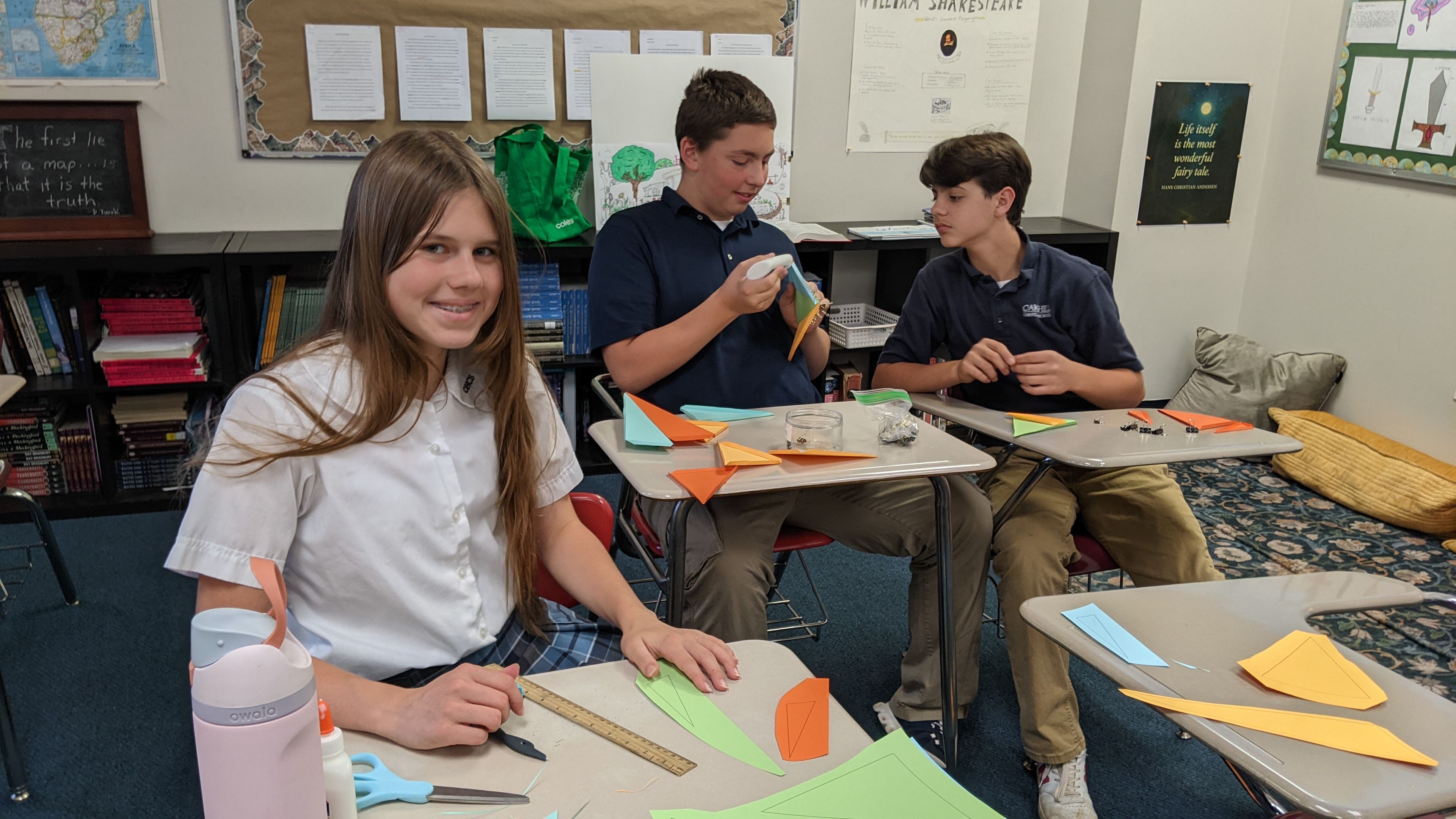
But where is the benefit? One might wonder. Isn’t math supposed to be practical? While many branches of math eventually become practical due to the order God has encoded into our world, to limit Math to the cold and practical is to skip over the juiciest bits of the meat! Math is the study of order, a concept nearly equivalent to beauty. What makes a painting pretty? Or a poem pleasing? It is its ordered structure. In math, we practice recognizing and applying order; we teach ourselves to think along abstract frameworks, and prepare ourselves for any such systems in the future. Whether drawing, speaking, or designing rockets, a true mathematician who has been taught to think in order will do it best.
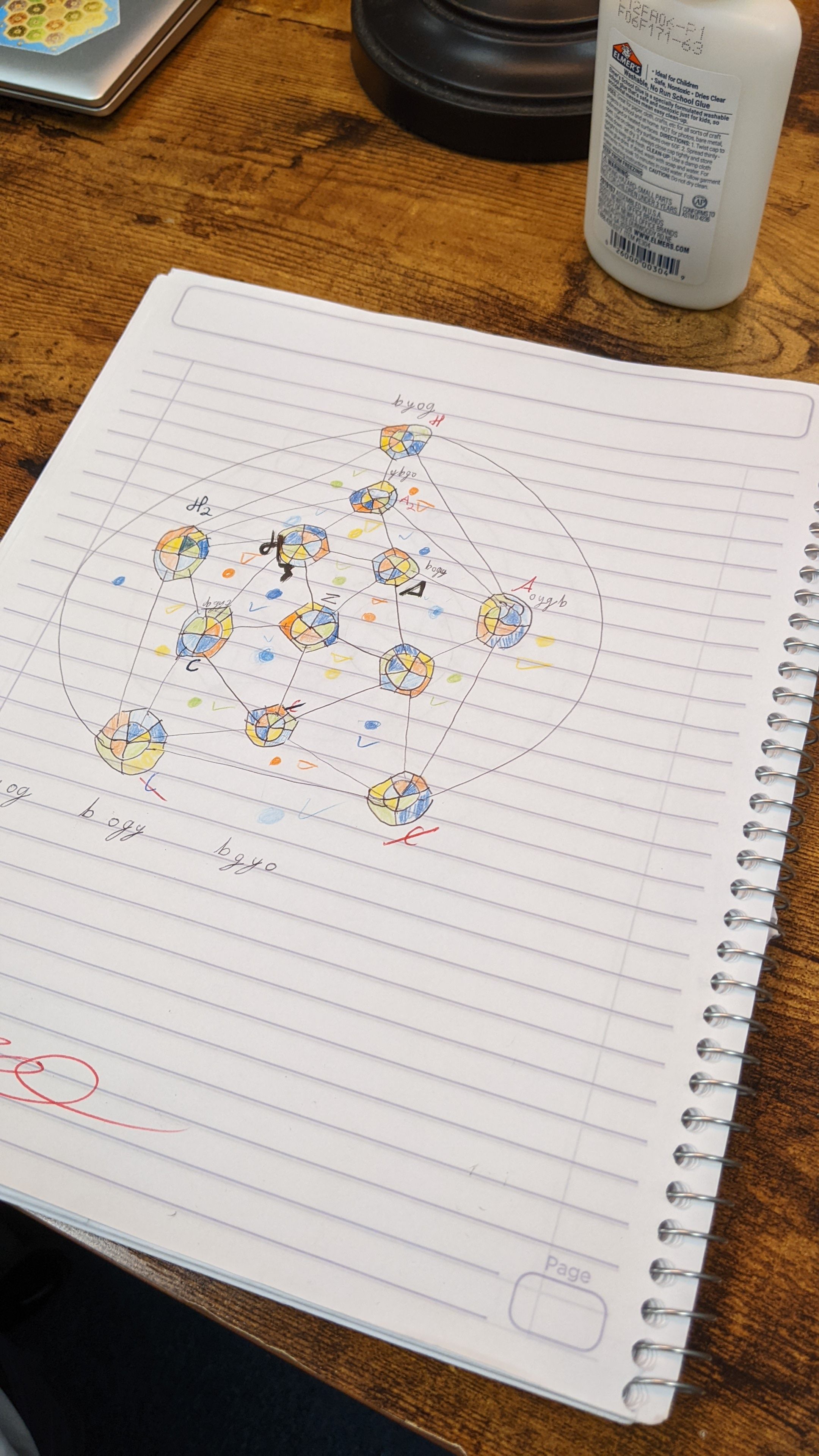
This is why we build polyhedra; we are building an object of order (note the shape's symmetry and color scheme, which though at first puzzling, reveals its order upon inspection). You could of course gain much by observing the shape, but to build it forces the mind into a deeper understanding. As we build different leaves and look for shortcuts we discover patterns a simple observer wouldn’t: the outer circles are the same order of color as the points they surround, just rotated; the junction of three cups always uses some color three times; these observations teach ordered thought better than reps of ratio problems ever could.
God has not made a chaotic world; sloth doesn’t become money, fish don’t become men, and men don’t become women. In a culture as confused as ours, it is imperative the next generation is trained in order, so they can see modern mythology for what it is. The world doesn’t need more people catechized in multiplication facts, it needs polyhedron builders.
by Caleb Thoburn, OH 2025. Caleb is a rising sophomore at New Saint Andrews College. He has loved and studied math all his life.